
Most development risk doesn't come from the market. It comes from the handoffs — the gap between the acquisitions team and the architect, between the architect and the general contractor, between the contractor and whoever eventually markets the finished unit. Each one of those seams is a place where a cost assumption can get lost, a timeline can slip without anyone quite owning it, and accountability can get deferred to "the other vendor." Vertical integration is the decision to close those seams by keeping every stage under one roof.
What Integrated Coordination Actually Means Here
For the principals, this isn't an abstraction: every aspect of the development process — acquisitions and entitlements, permits, construction, and the final sale or lease — is coordinated by the principals rather than handed across a chain of unrelated vendors and consultants. That structure doesn't eliminate development risk. It changes its character, from coordination risk that no single party is positioned to manage, to execution risk that the team can actually see and respond to directly.
Two outcomes from the team's own record show what that buys in practice: tighter budget control, and tighter schedule control.
What Integrated Coordination Buys: Budget Control
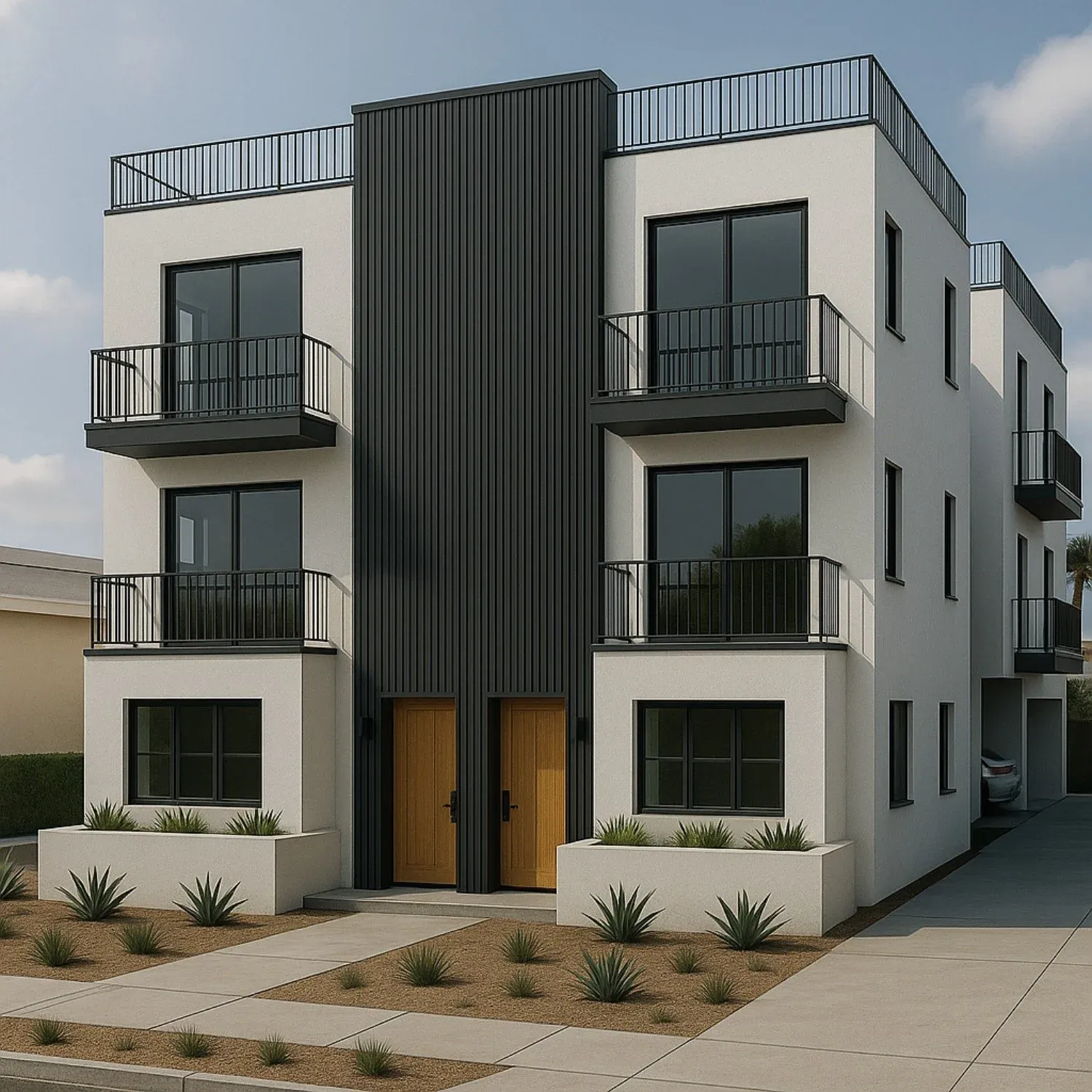
5651 Case Ave, a five-unit ground-up build, is the clearest reference point. The project was delivered under budget and subsequently refinanced, and is carried at an unrealized 2.4x equity multiple on $500,000 invested — a carrying value, not a realized result. Coming in under budget did more than protect margin on paper — it left the deal with the flexibility to refinance on favorable terms instead of needing to. That's what integrated cost control is actually for: not a bigger number at the end, but room to maneuver along the way, because the team setting the budget was the same team building to it, with no gap for a design decision to blow past a cost assumption unnoticed.
What Integrated Coordination Buys: Schedule Control
Timeline discipline shows up even more starkly in a direct comparison. 7932 Woodrow Wilson Dr, a studs-out Hollywood Hills remodel, returned a 2.54x multiple over a 24-month hold — roughly a 57% IRR. 7115 Macapa Dr, a remodel and FAR expansion, actually returned more on a multiple basis, 3.21x, but took 47 months to get there, which compresses that same success down to roughly a 37% IRR. The better multiple, held twice as long, produced the weaker annualized return.
That comparison is really a lesson about sequencing. Every additional month on a project carries financing costs, tax and insurance obligations, and market exposure that don't show up on a headline multiple but show up immediately in IRR. When acquisitions, permitting, construction, and disposition are coordinated by one team rather than negotiated across a chain of external vendors, the number of handoffs where a delay can originate goes down — not to zero, but meaningfully. Woodrow Wilson and Macapa were both successful exits. Only one of them was successful on schedule.
Fragmentation Is a Hidden Cost, Not a Detail
In a fragmented model, when something goes wrong, responsibility tends to scatter across whichever vendor was technically holding that piece of scope at the time. That diffusion is itself a cost, independent of whatever the actual problem was, because it slows the response and makes the next decision harder to make with full information. When one team owns acquisition through disposition, there's nowhere for that kind of ambiguity to hide — which is also why the reporting tends to be more accurate: it's generated directly by the people doing the work, not reconstructed after the fact from someone else's summary.
None of this is a guarantee against cost overruns or delays; both are always possible in development, integrated or not. What changes is which of those risks the team can actually see coming and adjust for internally, versus which ones depend on renegotiating with an outside party who has different incentives and a different tolerance for absorbing the cost of a mistake.
The Knowledge Compounds Too
There's a quieter benefit that doesn't show up in any single deal's numbers: lessons move faster when they don't have to cross a company boundary to be useful. A construction issue on one project informs how the next acquisition gets underwritten. A design tradeoff that caused friction during permitting gets built into the next set of plans before it becomes a repeat problem. That feedback loop is available to an integrated team in a way it isn't when acquisitions, design, and construction are three separate firms with three separate incentives and no shared memory of what went wrong last time. Scale, in this model, comes from repeatable systems rather than simply doing more deals — which matters, because more deals run through a fragmented process just means more opportunities for the same seams to fail.
The Case for Coordination Over Speed
Vertical integration is sometimes framed as an efficiency play, and it can be one, but that's not really the argument for it. The argument is that Case Ave's budget discipline and the Woodrow Wilson–Macapa timeline gap are the same story told twice: keeping acquisition, permitting, construction, and disposition under a single accountable team doesn't just make a project move faster. It removes the seams where a cost assumption or a schedule slip would otherwise have nowhere obvious to be caught.
Project results referenced in this article were achieved by the principals through Thornton Development Group and affiliated entities. Thornton Development Group is an independent company operated by the same principals who manage Assemble Capital; the two are separate companies. These projects were not Assemble Capital offerings and did not involve Assemble Capital investors. Figures are sponsor-level, unaudited, and drawn from internal records. Past performance is not indicative of future results.
This article is for general informational and educational purposes only. It is not, and should not be relied upon as, investment, legal, tax, or accounting advice, and it is not a recommendation or endorsement of any strategy or investment. Consult your own financial, tax, and legal advisors before making any investment decision. See our full Risk Disclosures for additional information.


Future Opportunities
Want to invest in the next one?
Get in touch and we'll walk you through the model, the pipeline, and what a specific offering looks like.
Contacting us is not an offer, commitment, or investment. Any offering is made only through definitive offering documents to eligible investors.