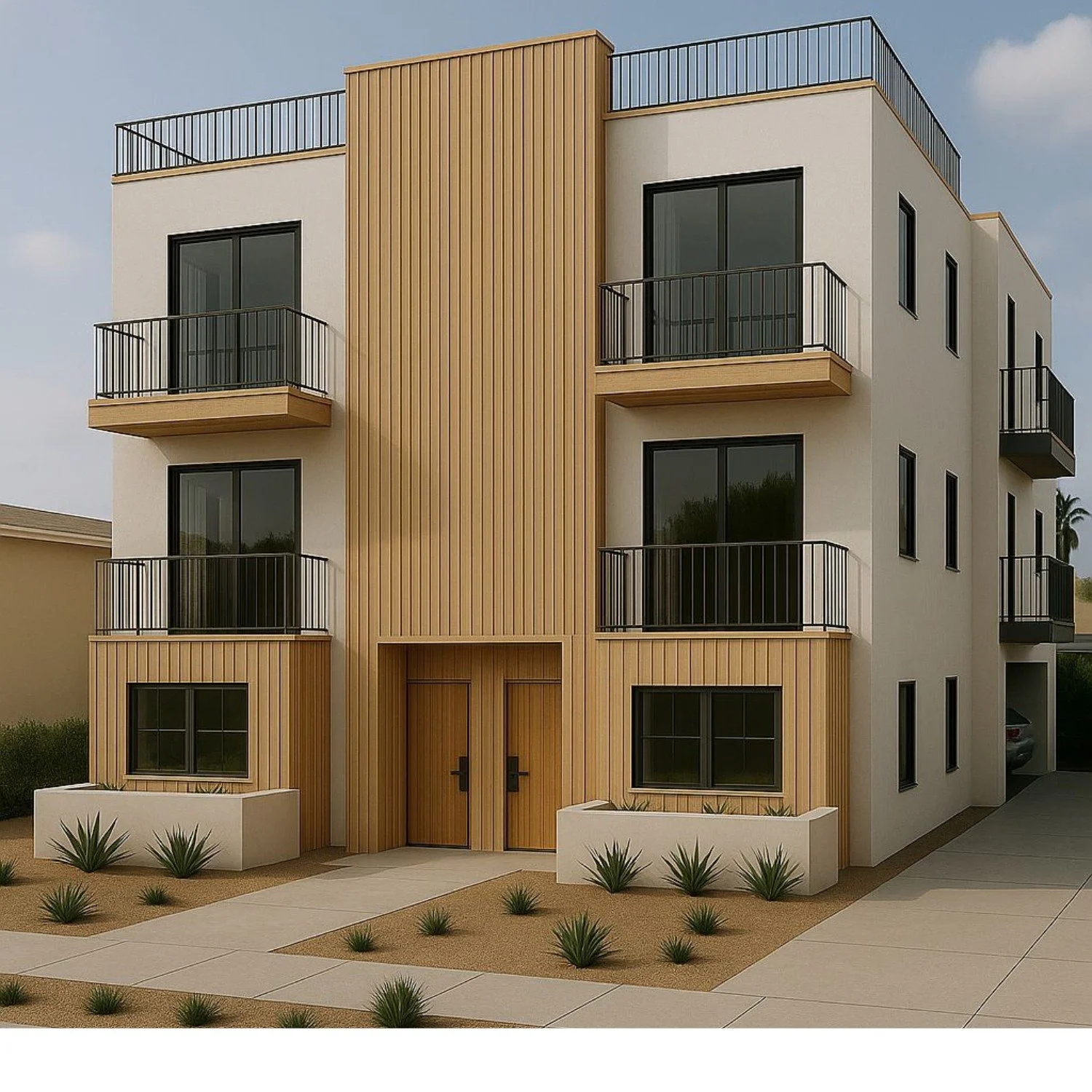
3 – 4
Units per project
Strategy 04 · TIC
Small multifamily sold as individual tenancy-in-common homes at a premium to bulk value.
Underwriting targets, not promises or guarantees. Individual investments may vary; final parameters are governed by each investment's definitive documents.
The Reasoning
An investor buys a cap rate. A homeowner buys a home. The gap between those two prices is the strategy.
Tenancy-in-common allows a small apartment building to be sold as individual homes to individual buyers, each taking an undivided fractional interest with exclusive right to occupy a specific unit. It exists because condominium conversion in Los Angeles is heavily restricted — TIC is the structure that reaches the for-sale buyer in buildings that cannot legally be condo-mapped — we cover the mechanics in full in our guide to tenancy in common in Los Angeles.
The economics come from who is bidding. An investor purchasing a three-unit building prices it on income — rents, expenses, a cap rate. Three separate homebuyers price the same square footage as places to live. On a small building that spread between aggregate unit value and bulk value is meaningful, and capturing it is the entire thesis.
The structural constraint used to be financing: TIC buyers historically needed to pay cash or take a shared blanket loan. Fractional TIC lending has matured, with multiple lenders now writing individual loans against individual interests, which is what makes the strategy executable at scale rather than a curiosity.
The tradeoff is honest and it is absorption. Each unit waits on its own buyer securing their own financing, and a sellout takes time. 5832 David returned 1.41x and roughly 17% IRR over 26 months — the most modest of our realized exits. What that project bought was a documented, executed template, which is now being applied at 1925 19th St.
How It Works
Unit buyers pay for a home; the spread over bulk investor value is the return driver.
The legal structure that reaches for-sale buyers in buildings that cannot be condo-mapped.
Individual TIC loans are now available from multiple lenders — the constraint that historically limited this strategy.
Bulk-sale value, partial-release terms, and absorption assumptions are set before acquisition, not after.
Current Projects
Track Record
5832 David was sold as three separate TIC units across closings from November 2025 through February 2026. It is the executed proof of the pathway now being applied at 1925 19th St in Santa Monica.
What Can Go Wrong
Every strategy has a failure mode. These are the ones specific to this one — the complete risk disclosure for any investment lives in its offering documents.
Future Opportunities
Future projects in this strategy are capitalized through new project-specific offerings — an 8% preferred return paid before the sponsor participates, Class A participation in the profits, and our own capital in every deal. Terms shown are typical of prior offerings and are not an offer; the final terms of any investment are governed solely by that project's private placement memorandum and operating agreement. Get in touch and we'll walk you through the model, the pipeline, and what a specific offering looks like.
Contacting us is not an offer, commitment, or investment. Any offering is made only through definitive offering documents to eligible investors.